


PP Compression Fittings · Farm Irrigation
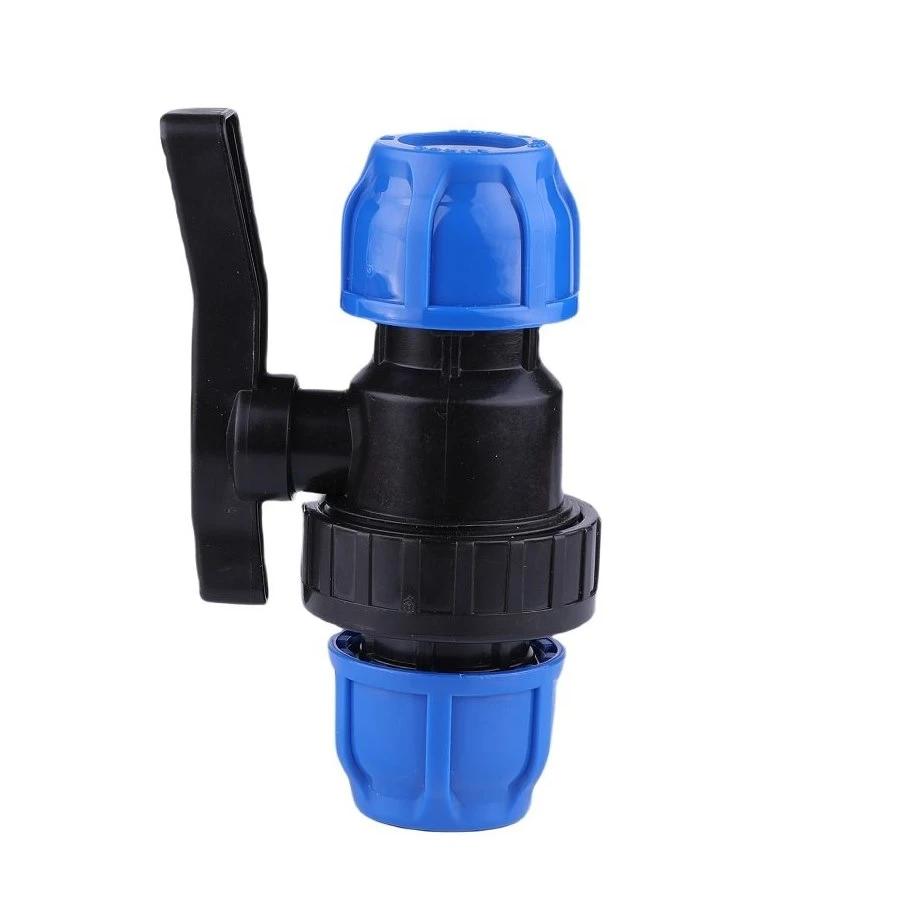
PP Farm Irrigation Compression Ball Valve
On an irrigation line the valve is the part someone reaches for every day - to close a zone, stop a leak, or empty a header before the cold. This one is built for that job: both ends take plain pipe and lock down with a clamp ring, and a quarter turn on the handle cuts the flow completely. A wrench is all it asks for.
Quarter-turn shut-off 20 – 110 mm Working pressure to 1.6 MPa Fits PE & PP pipe
|
90°
Full open to full shut
|
9 sizes
20 mm to 110 mm
|
1.6 MPa
Working pressure
|
−10 to 60 °C
Service temperature
|
Overview
Two jobs in one fitting: a shut-off valve and a pipe joint
Most valves need a thread, a flange or a weld to get onto the line. This one doesn't - it clamps on, the same way the rest of a compression system does.

A compression ball valve is a ball valve whose two ends are compression sockets rather than threads. Inside the body sits a bored ball, turned by the lever on top. At each end, an EPDM O-ring is trapped between the pipe and the socket and squeezed into place by a nut and clamp ring.
That combination is what makes it useful in a field. A grower who wants to add a shut-off point to an existing mainline does not have to cut the pipe, thread it, or bring a fusion machine out to the plot. He cuts the pipe square, pushes each end into the valve, tightens two rings, and the line has a valve on it. Half an hour, one person, one wrench.
We mould the body, ball and handle in polypropylene, source the seals in EPDM, and assemble and test every valve in the plant. The valve is offered from 20 mm up to 110 mm, which covers the mainlines and sub-mains used in drip, sprinkler and orchard irrigation as well as the smaller laterals.
How It Works
Where the water goes when you move the handle
Three parts do all the work: the lever, the ball, and the two sealed ends.
1. The lever sets the position
The handle is a straight lever, not a wheel. In line with the pipe it means open; across the pipe it means shut. One 90-degree swing takes it from one to the other, so there is no guessing and no winding a stem for twenty turns.
2. The ball carries the bore
A sphere with a hole through it sits between two seats. Open, the hole lines up with the pipe and the water passes through an almost straight path; closed, the solid part of the sphere faces the flow and the line is dead-ended.
3. The ends do the sealing
Each socket holds an O-ring that the clamp ring compresses against the pipe wall. Two independent seals, one at either end, so a joint that is slightly tight or slightly loose on one side still holds on the other.
Product Views
The valve itself, and the range it comes in
Photographed in our own plant. Body, handle and clamp rings shown as they are supplied - no branding on the fitting, because the label is yours.

Handle, body and clamp ring - the three parts that matter on site. |

Small, medium and large: the same design runs from 20 mm up to 110 mm. |
Advantages
What a grower notices after a season in the field
The benefits that matter are the practical ones: it goes on fast, it shuts clean, and it survives sun and mud.
|
One quarter turn, fully shut No multi-turn stem to crank. A single 90-degree movement closes the valve against full line pressure, which is what you want when a fitting bursts and the crop is standing in water. |
Full bore, little pressure loss The ball's opening matches the pipe bore, so an open valve adds almost nothing to the friction of the line. Pump head stays where the irrigation design put it. |
|
Fitted with a wrench, not a welder Both ends clamp onto plain pipe. There is no thread to cut, no sealant to spread, no fusion joint to cool. A crew can add a valve mid-line without pulling the whole run apart. |
Sealed at both ends Each socket has its own EPDM O-ring and its own clamp ring. One end holding firm does not depend on the other, and a small difference in pipe fit is absorbed by the seal rather than passed on as a leak. |
|
Built to live outdoors UV-stabilized PP body, EPDM seals and a working range of about −10 °C to 60 °C. It is meant to sit in sunlight, dust and spray for season after season. |
Take it off and use it again Loosen the two rings and the valve comes off the pipe intact. When a zone is re-laid or a line is shortened, the valve moves with it instead of being scrapped. |
Sizes & Ratings
The range, and what each size will take
Sizes are given by the outside diameter of the pipe the valve accepts, which is how compression fittings are matched in practice.
| Valve size | Working pressure | Burst pressure | Temperature | Body |
|---|---|---|---|---|
| 20 mm | 1.6 MPa | ≥ 3.0 MPa | −10 to 60 °C | PP |
| 25 mm | 1.6 MPa | ≥ 3.0 MPa | −10 to 60 °C | PP |
| 32 mm | 1.6 MPa | ≥ 3.0 MPa | −10 to 60 °C | PP |
| 40 mm | 1.6 MPa | ≥ 3.0 MPa | −10 to 60 °C | PP |
| 50 mm | 1.6 MPa | ≥ 3.0 MPa | −10 to 60 °C | PP |
| 63 mm | 1.6 MPa | ≥ 3.0 MPa | −10 to 60 °C | PP |
| 75 mm | 1.6 MPa | ≥ 3.0 MPa | −10 to 60 °C | PP |
| 90 mm | 1.6 MPa | ≥ 3.0 MPa | −10 to 60 °C | PP |
| 110 mm | 1.6 MPa | ≥ 3.0 MPa | −10 to 60 °C | PP |
The figures above are reference values for the standard design. The rating confirmed for your order depends on the pipe wall thickness you will use and the working conditions on site - send those details with your enquiry and we will confirm the size and class that suits.
Where It Is Used
Places on a farm where a valve like this earns its keep
Field irrigation is full of points where water needs to be stopped quickly, by hand, without shutting the pump.
|
1. Closing a drip zone One valve at the head of each block lets a manager water one section while another is being repaired or rested. |
2. Orchard block isolation Between tree rows, a valve on the sub-main allows a single block to be cut off for pruning, spraying or replanting. |
|
3. Greenhouse bench lines Bench and misting lines get their own shut-off, so a bench can be isolated while the rest of the house keeps watering. |
4. End-of-line flushing Mounted at the low end of a line, it opens to dump sediment and closes again without a cap to unscrew and lose. |
|
5. Tank and pump outlets A hand valve on the outlet of a storage tank or a small pump set, closing the flow before maintenance work begins. |
6. Seasonal and temporary rigs Hire equipment, market gardens and rented plots - where the valve has to come off at the end of the season and go back on next year. |
Fitting On Site
Three steps, one wrench, no heat
The same method as any compression fitting - the only difference is that this one has a handle to check afterwards.
1. Cut the pipe clean
Cut both pipe ends square with a pipe cutter or a sharp saw, then wipe off burrs and soil. A ragged end will push the O-ring out of its groove instead of sliding past it.
2. Push each end home
Slide the clamp ring back, push the pipe into the socket until it stops against the internal shoulder, then bring the ring up to the body. Do the same at the other end.
3. Tighten, then test the handle
Run the rings down hand-tight, then firm them with a wrench - firm, not forced. Open and close the lever once, pressurize slowly, and check both ends for weeping before backfilling.
Material & Testing
What is inside the body, and how we check it
A valve that fails is worse than no valve at all - it fails while the line is under pressure. So the checks matter more here than on a plain coupling.
Virgin polypropylene, not regrind
The body, ball housing and handle are moulded from virgin PP. No reclaimed scrap in the mix means consistent wall strength, consistent color, and no hidden weak point in a pressure part.
Seals chosen for water, not for looks
EPDM is used at both ends because it holds up in cold water, warm water and the mildly chemical water that comes out of a fertigation tank. The ball seats are matched to the same duty.
Every valve operated and pressure-tested
Each unit is turned open and shut on the bench, then held under pressure with the valve both open and closed. Leaks past the ball, or at either end, are caught here rather than in a customer's field.
Certification to your market
Production runs under an ISO 9001 quality system, and we can supply to ISO, CE, GOST or Watermark requirements depending on where the goods are going. Tell us the destination and the standard it must meet.
ISO 9001 ISO CE GOST Watermark
Choosing A Valve Type
Ball valve, brass valve or gate valve - which belongs on the line
All three stop water. They differ in how fast they act, what they cost, and what it takes to fit them.
| Point of comparison | PP compression ball valve | Threaded brass valve | Gate valve |
|---|---|---|---|
| Fixing to the pipe | Clamp ring, plain pipe | Threaded nipple required | Flange or weld |
| Tools on site | One wrench | Pipe threader and wrench | Welder or flange kit |
| Speed of shut-off | Quarter turn | Quarter turn | Many turns |
| Pressure loss when open | Very low, full bore | Low | Low |
| Corrosion in wet soil | PP, unaffected | Brass can dezincify | Depends on body metal |
| Typical cost | Moderate | Higher | Highest |
| Best suited to | Field irrigation lines | Indoor and potable lines | Large mains, low cycling |
On a farm line, the deciding factors are usually installation and corrosion rather than the last fraction of a bar. A plastic compression valve removes the threading step and takes the rust question away entirely.
OEM / ODM
Supplied under your name, to your sizes
Importers, distributors and irrigation brands use us as the factory behind their catalogue.
Size and color to order
The standard set is blue and black; other body and handle colors can be run to your spec, along with sizes outside the listed range.
Your logo on the goods
Pad printing and label options on the body and on the packing, so the carton that arrives in your warehouse carries your brand, not ours.
Samples, then volume
We will send a sample for your own pressure test before a bulk order, so the valve is proven on your pipe and your water before you commit.
Questions Buyers Ask
Straight answers before you order
What exactly is a PP compression ball valve?
It is a quarter-turn ball valve with compression ends instead of threaded or welded ends. Each end takes a plain pipe, an EPDM O-ring sits between the pipe and the body, and a clamp ring tightens down to press the seal home. You need a wrench, not a fusion machine.
Which pipe sizes does the valve fit?
The standard range runs from 20 mm to 110 mm, covering 20, 25, 32, 40, 50, 63, 75, 90 and 110 mm. Each valve is matched to the outside diameter of the pipe it will carry, so tell us the pipe OD rather than a nominal bore when you order.
Can I use it to throttle flow, or only to open and close?
It is built primarily as a shut-off valve. A ball valve will throttle if you park the handle part way, but the seat wears faster when it is held half open against flowing water. For regular flow regulation, use a dedicated control valve and keep this one fully open or fully closed.
Will it fit the PE pipe I already have in the field?
In most cases yes. The compression ends are designed for PE and PP pipe of matching outside diameter. Check that your pipe OD matches the valve size and that the wall is within the normal range for that diameter; if it is an unusual wall thickness, send us the detail and we will confirm the fit.
How do I tell whether the valve is open or closed?
The handle shows it. When the handle is in line with the pipe, the bore is open; turned across the pipe, the valve is shut. A quarter turn, 90 degrees, moves it from one position to the other.
Can it stay outside all season?
Yes. The body is UV-stabilized polypropylene and the working range is roughly −10 to 60 °C, which suits field irrigation. In hard frost, drain the line or remove the valve rather than leaving water trapped inside it.
Contact
Tell us the pipe size and the pressure you work at
Send the pipe OD, the quantity you need and where the goods are going. We will come back with a price on the right valve, not a general list, and confirm the lead time at the same time.
Email: sales01@lvzhoupipe.com
Mobile / WhatsApp: +86 13325827191
WeChat: +86 15712065269
Address: No. 88, Hongyun Blvd, Hongqiao Town, Changxing County, Huzhou, Zhejiang 313107, China
Zhejiang Lvzhou Pipe Technology Co., Ltd. - manufacturer of PP and PE pipe fittings for farm irrigation and low-pressure water supply, with OEM / ODM service.
Hot Tags: pp farm irrigation compression ball valve, China pp farm irrigation compression ball valve manufacturers, suppliers, factory


